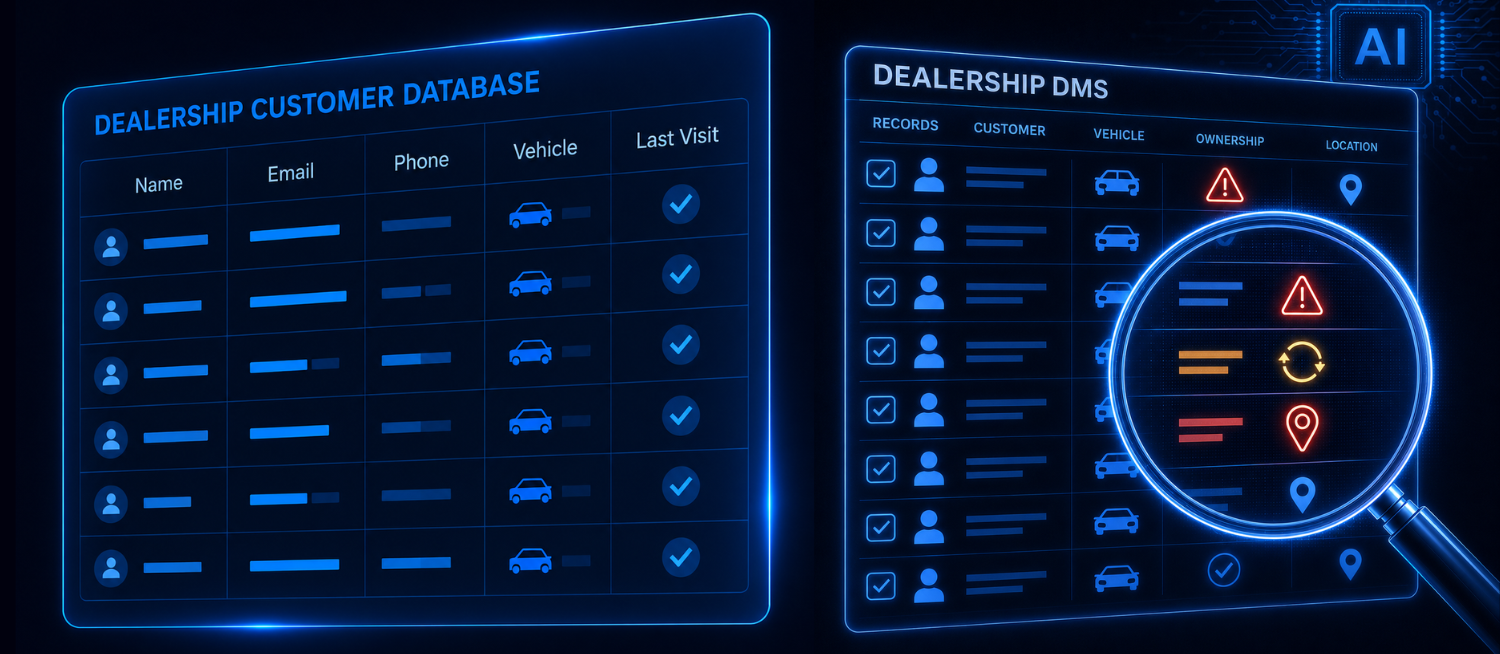
Ownership Accuracy, Out-of-Market Customers, and Customer Duplication
OWNERSHIP ACCURACY, OUT-OF-MARKET CUSTOMERS, AND CUSTOMER DUPLICATION
One of the most overlooked problems in dealership marketing is ownership accuracy.
That may sound like a simple data issue, but it has a major impact on fixed operations, service retention, recall marketing, declined service follow-up, customer lifecycle campaigns, BDC productivity, reporting, and now AI. Before a dealership spends money trying to bring a customer back into the service drive, there are a few basic questions that need to be answered.
Does that customer still own the vehicle?
Is that vehicle still in the dealership’s market?
Is the customer record accurate?
Or is the dealership really looking at an outdated, duplicated, or incomplete version of the customer?
Those questions matter because a dealership can have the best offer, the best creative, the best technology, and the best AI platform, but if the customer no longer owns the vehicle, no longer lives within a realistic service area, or exists in the DMS under multiple customer records, the campaign is already working from a weak foundation.
That is not a marketing problem.
That is a data problem.
I have seen this issue inside dealerships for years. A customer buys a vehicle, services it for a while, then trades it somewhere else, sells it privately, gives it to a family member, moves out of town, or simply disappears from the dealership’s service lane. But inside the DMS, that customer may still look like an active owner.
In other cases, the customer may still be active, but the dealership does not have a clean view of the relationship. The customer may have one record from the original sale, another record from service, another record tied to a recall, and another record created because a service advisor could not find the original profile fast enough.
Now the dealership has one real customer showing up as multiple customer records.
That creates a major problem.
The sales record may not show the service history. The service record may not connect to the vehicle purchase. A recall opportunity may be tied to one customer number while a declined service opportunity is tied to another. The dealership may think it is looking at several different customers when it is really looking at one person with a fragmented history.
That is how campaigns get off track before they ever launch.
A service reminder goes out. A recall notice goes out. A maintenance offer goes out. A declined service follow-up goes out. A BDC call gets made. A text message gets sent. A direct mail piece gets mailed.
But if the ownership data is wrong, the customer moved out of market, or the customer record is duplicated, the dealership may be spending money on an audience that is not as clean or actionable as it appears.
That is wasted spend, wasted time, and a missed opportunity to focus on customers who are actually in position to do business with the dealership.
Ownership accuracy is especially important in fixed operations because service marketing is tied directly to the vehicle. If the wrong person is attached to the vehicle, everything downstream becomes weaker. The offer may be wrong. The timing may be wrong. The message may be wrong. The customer experience may be wrong. The reporting may be wrong.
Customer duplication creates the same kind of problem. If the dealership cannot see the full customer relationship in one accurate view, the campaign may miss the real opportunity. A customer who looks lost may actually be active under another record. A customer who looks like a strong service opportunity may no longer own the vehicle. A customer who appears to have no declined service may have declined work sitting under another customer number.
And now, with AI, the risk becomes even greater.
AI does not automatically know that the customer traded the vehicle. It does not automatically know that the customer moved from Jacksonville to Atlanta. It does not automatically know that the vehicle is now registered to someone else. It does not automatically know that three customer numbers should really be connected to one person.
AI uses the data it is given.
If ownership data is wrong, AI builds strategy on the wrong foundation. If customer records are duplicated, AI may misunderstand the customer relationship. If the customer is out of market, AI may still treat that person like a realistic service opportunity.
That is why ownership validation, location accuracy, and customer deduplication all matter.
A dealer should not assume that because a customer bought from the store three years ago, they are still a service opportunity today. A dealer should not assume that because the vehicle is still in the DMS, the original buyer still owns it. A dealer should not assume that every record in the database is reachable, relevant, accurate, and still in market.
Those assumptions cost money.
One of the first things dealers need to understand is that a record in the database is not the same thing as a real marketing opportunity. A record may exist, but that does not mean it is worth marketing. The dealership needs to know whether the customer still owns the vehicle, whether the vehicle is still in a realistic service market, whether the contact information is valid, and whether the customer profile is complete enough to support the campaign being sent.
That last point is important.
If a customer moved 80 miles away, they may technically still own the vehicle, but are they likely to come back to your service drive for an oil change, tires, brakes, or routine maintenance? Maybe not. If they moved 200 miles away, the answer is probably no. If they moved out of state, continuing to include them in routine service campaigns is almost certainly waste.
That is why out-of-market suppression is so important.
Dealers need to define what a realistic service market actually looks like. That may vary by brand, dealership location, customer type, service category, and opportunity. A luxury customer may travel farther for certain repairs. A recall customer may behave differently than a routine maintenance customer. A high-value declined service opportunity may deserve a different outreach strategy than a basic lube, oil, and filter reminder.
But the dealership still needs a process.
The dealership needs to know which customers should remain in the campaign, which customers should be suppressed, which customers should receive a different message, which customers should be moved to a lower-cost channel, and which records should be reviewed before more marketing dollars are spent.
Those decisions directly affect marketing efficiency and fixed ops performance.
A customer who still owns the vehicle and lives within five miles of the dealership may be a strong service retention opportunity. A customer who still owns the vehicle but lives 70 miles away may need a different strategy. A customer who no longer owns the vehicle should not be treated like an active service customer. And a customer who exists under multiple customer numbers should not be marketed to as if each record represents a different person.
This is where many dealerships get into trouble. They market to the database instead of marketing to the real opportunity.
There is a difference.
A database is a collection of records. A real opportunity is a cleaned, validated, deduplicated, and segmented group of customers who are most likely to produce a meaningful result.
That is where ownership accuracy becomes valuable.
When a dealer knows who still owns the vehicle, where that vehicle is located, and how the customer relationship is connected across sales, service, recall, and declined service data, marketing becomes more precise. Service reminders become more relevant. Recall outreach becomes more accurate. Declined service campaigns become more focused. Customer lifecycle marketing becomes more intelligent. BDC teams spend time on better opportunities. Reporting becomes easier to trust. AI has better information to work with.
When the dealership does not know, the opposite happens.
Customers receive irrelevant messages. Marketing dollars are spent on weak or dead opportunities. Duplicate records distort the size of the audience. Vendors may claim inflated results. BDC teams waste time. Reports become harder to trust. The dealership may think the campaign underperformed, when the real problem was that the audience was wrong before the campaign ever started.
One of the most common examples is recall marketing. A dealership may pull a list of open recalls and start contacting customers based on the records available. But if the ownership information is outdated, that campaign can quickly lose efficiency. The customer may have sold the vehicle, traded it at another store, moved out of market, or no longer be reachable at the contact information on file.
Customer duplication can make that even worse. The dealership may have one record showing an open recall, another record showing recent service, and another record with updated contact information. If those records are not connected properly, the dealership may not have a clear picture of who to contact, what message to send, or whether the customer is still a realistic opportunity.
That does not mean recall marketing is not valuable. It is extremely valuable when it is built correctly. But the ownership data has to be validated, the customer record has to be cleaned, and the campaign audience has to be built around customers who actually represent an opportunity.
Declined service is another example. If a customer declined work 12 months ago but no longer owns the vehicle, that follow-up campaign is not going to produce the intended result. If the customer moved too far away, the message may not matter. If the declined service is sitting under one customer record while the current ownership information is tied to another, the dealership may not see the situation clearly.
Again, the campaign is not the starting point.
The data is.
Dealers also need to understand the relationship between ownership accuracy and customer experience. If a customer keeps getting messages about a vehicle they no longer own, it makes the dealership look disconnected. If they receive a recall notice for a vehicle they traded, they may ignore future communication. If they continue getting service offers after they have told the dealership they sold the vehicle, the communication becomes annoying.
The same thing happens with duplicate records. If one department has updated information and another department is still using an old record, the customer sees the dealership as disorganized. They do not know which system caused the problem. They do not care which vendor sent the message.
They blame the dealership.
That hurts trust.
Customers expect the dealership to know them. They expect the dealership to understand what they own, what they need, and why the message is being sent. When the data is wrong, the message feels random. When the message feels random, engagement drops.
This is why data quality has to be treated as part of the customer experience strategy.
It is not just about cleaning files. It is about making sure the dealership communicates like it actually knows the customer.
So, what should dealers be doing?
First, dealers should stop assuming that DMS ownership records are always current. The DMS is important, but it is not always enough by itself. Customers trade vehicles elsewhere. They sell privately. They move. They change phone numbers. They update emails. They service elsewhere. The dealership needs a way to validate and refresh the data before campaigns are launched.
Second, dealers should identify and resolve duplicate customer records. If one customer exists under multiple customer numbers, the dealership does not have a clean view of that relationship. Sales, service, recall, declined service, and customer lifecycle data need to be connected as accurately as possible so the dealership can market based on the full customer picture.
Third, dealers should separate active owners from questionable records. If ownership cannot be reasonably validated, the customer should not automatically be treated like a high-confidence service opportunity. Those records may need a different communication strategy or additional verification before the dealership spends money on higher-cost channels.
Fourth, dealers should define market boundaries. Not every customer in the database is equally likely to return for service. Distance matters. Drive time matters. Service type matters. Brand loyalty matters. Customer value matters. Dealers should not use one blanket rule for every campaign, but they should have a clear method for deciding who is in market and who is not.
Fifth, dealers should use returned mail, bad emails, disconnected numbers, and customer feedback to improve the database. Every failed contact attempt is information. If a mail piece comes back, that should update the record. If a customer says they sold the vehicle, that should be recorded. If a phone number is bad, that should be corrected or suppressed. The worst thing a dealership can do is continue paying to use bad information over and over again.
Sixth, dealers should ask vendors how ownership, marketability, and duplication are being handled. This is one of the most important questions a dealer can ask. How do you know the customer still owns the vehicle? How do you know the customer still lives close enough to be a real service opportunity? How are out-of-market records handled? How are duplicate customer records identified? How are sold, traded, moved, or unreachable customers suppressed? Can you show me what was removed from the campaign and why?
Those questions matter because they reveal whether the campaign is built on real opportunity or just raw volume.
At Dealerwing, this is one of the areas where we believe dealers can create a major advantage. We help dealerships look beyond the surface-level database and identify which customers are actually marketable, reachable, relevant, and in market. Our tools are designed to help validate customer and vehicle data, identify ownership issues, improve segmentation, reduce duplication, suppress waste, and support smarter fixed ops marketing.
Ready to Take Your Dealership’s Marketing to the Next Level?
Dealerwing specializes in AI-driven marketing solutions designed to increase service retention, optimize ad spend, and drive measurable results. Let’s build a smarter, more profitable marketing strategy for your dealership today.